On Thursday I found another Firecrest, this time in some bramble in Black Poplar wood giving fantastic views down to two metres! Sadly the heavy rain showers had forced me to leave my camera back in the yard.
On Wednesday, a look out of the office window while doing some bird count data entry into the computer saw me staring at a Great White Egret on the saltmarsh. This is the second day its visited the patch this year so it was good to get it on my Patchwork Challenge list.
Other birds that have made it onto the list include Grey Plover, Golden Plover, Red-breasted Merganser and Red Kite.
This week we've been making repairs to the banks at Water Vole City to make it more safe for the children to play at. On Friday we spent the morning digging a water drainage channel next to a track so that the verge will hopefully dry up allowing a lorry to come in to fix the Heron hide toilets without getting stuck!
Sunday, 1 February 2015

Wednesday, 28 January 2015
Tricky Grebe
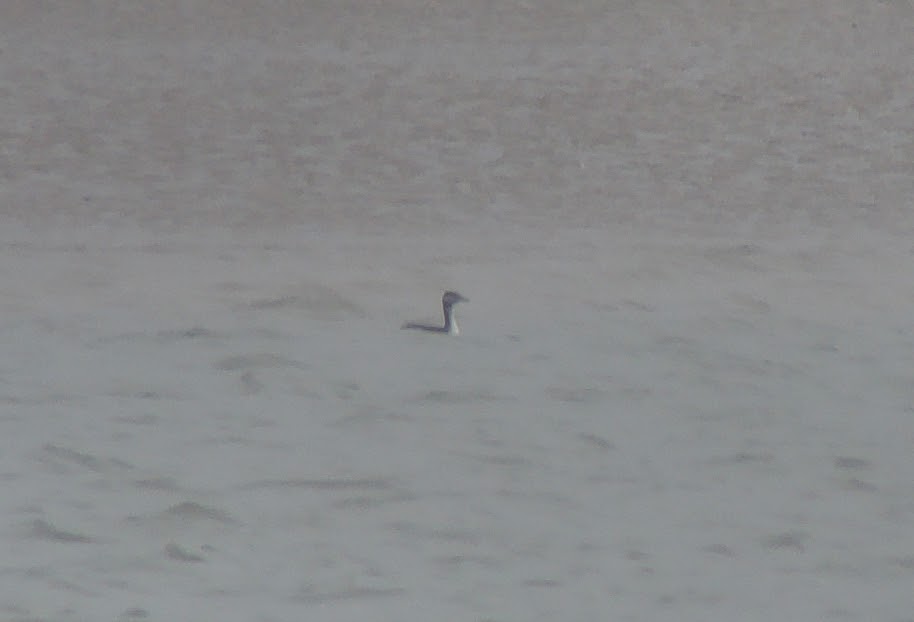
I went to Whitford on Sunday with the Gower birding group. The saltmarsh area had large numbers of Wigeon, Teal and Pintail, as well a Great White Egret, and a Merlin hunting overhead. An interesting looking grebe was found out on the estuary fishing up one of the channels. It was always distant, and with poor light it was hard to pick out much detail. It had a dusky head with undefined markings making it look good for Red-necked Grebe. It also at times seemed very long necked and long bodied. However, the beak always looked short through the scope and I couldn't detect any yellow at the base. Size was hard to judge, but when a Great Crested Grebe was briefly in the same view it looked a little on the small side for Red-necked to me. The other possibility is that it's a Slavonian Grebe moulting into summer plumage making the head markings less defined. I think the only way to know for sure is if better views are obtained, so hopefully it'll be re-found. I'm completely torn either way, but perhaps slightly more on the Slav side because of the shortness of the beak.


Offshore there were two Great Northern Divers, a Slavonian Grebe and c.40 Eider.
 |
| Grebe sp. |
 |
| Eider |
Saturday, 24 January 2015
GNDs and winter Whimbrel
A walk along the coast path to Pwll on a calm sunny day was surprisingly profitable for birds. I wader in a field by the water treatment works caught my eye - a Whimbrel! It seemed unbothered by passing dog walkers, and only flew when they got too close. Luckily it flew in and landed at about ten metres distance from me calling as it did so. Not the most well marked bird. The feathers are very worn and it only showed a weak crown stripe.

Off the estuary wall were, 13 Great Crested Grebe, 10 Red-breasted Merganser, a Little Grebe and three Great Northern Divers close in feeding on crabs. Nice to see this species at such close range.
Two Chiffchaffs in the bushes by the side of the path were noteworthy, as was a female Goldeneye on the lake just to the east of Sandy Water Park and two Red Kites overhead.
 |
| Whimbrel |
 |
| 1st winter Great Northern Diver |
Wednesday, 21 January 2015
Firecrest
There's a nice scrubby area just by the entrance to the yard with a few pine trees. There's nearly always a few Goldcrests here, and I'm forever checking them for anything rarer. Today, we'd just been doing some habitat hedging on the reserve, and on my way back into the yard for lunch a crest was flitting about in the area. I got a view of its bright greeny orange back, and then it turned to the side to reveal a white supercillium - Firecrest! It quickly moved into denser cover where I watched it skulking about for about ten minutes before it disappeared. Hopefully it'll bring in a few more visitors!
Yesterday, I found my first dead bird since I've started working here - a Herring Gull on one of the roost islands of the saline lagoon. Luckily there weren't many birds (or birders!) to disturb so we put on some waders and went out to collect it. I took both a buccal swab and a cloacal swab, and after a lot of form filling in, took them to the post office to get sent to a lab for analysis for disease. The bird has been frozen just in case a post mortem needs to be carried out.
On Monday I had my first opportunity to photograph the Bittern. I first picked it up in a line of sedge at the end of the channel we created a couple of months ago, but it soon flew in and landed on the opposite side of the lake, unfortunately just behind a small island.
 |
| The only shot I got of it! |
 |
| Me swabbing a dead Herring Gull. |
 |
| Bittern |
Sunday, 18 January 2015
Partially leucistic Teal
A Teal has been around for at least three or four months now with an area of leucism on both sides of its head. When I first saw it it was in eclipse with the same white markings, so its been interesting to see it moulting into breeding plumage. It also has small areas of white in the wing and on the outer tail feathers.
On today's WeBS count, a Kingfisher was showing nicely at the Canoe Safari and four Spotted Redshanks were on the Saline Lagoon along with eight Greenshank. A few additions to the 2015 patch list include a Raven, a Stock Dove, 11 displaying Goldeneye and a Bittern on Thursday afternoon. Still plenty of easy ones to get; Coal Tit, Treecreeper and Mistle Thrush to name a few.
Work over the last week has included all the usual stuff like entering the wildlife we see onto a database and doing the dead bird patrol. This week we had to train other members of staff how to take swabs of dead birds in case they found any at the weekend.
We've also been clearing a bank to provide an increased area for Water Voles to breed and feed on. We started off checking for signs on Monday - none in the area we were going to clear, but we found food stashes in an area of sedge adjacent. We started off by strimming the bramble away and then cut down the 25 odd trees. All of the branches were made into hedges to provide a place for insects to winter, and the logs are hopefully going to be sold.
The tree stumps will be poisoned, and throughout the spring the sedge should begin to grow.
 |
| Teal |
 |
| Kingfisher |
We've also been clearing a bank to provide an increased area for Water Voles to breed and feed on. We started off checking for signs on Monday - none in the area we were going to clear, but we found food stashes in an area of sedge adjacent. We started off by strimming the bramble away and then cut down the 25 odd trees. All of the branches were made into hedges to provide a place for insects to winter, and the logs are hopefully going to be sold.
 |
Sunday, 11 January 2015
New Year
I've signed up to Patch Work Challenge this year using the WWT reserve as my patch. I'll only have until August to try and see as many species as possible, but I should be able to manage 120, and hopefully a few more.
The highlights of last week were a female Goldeneye on the estuary and four Spotted Redshank amongst the waders.
Work last week mainly consisted of cutting down dangerous trees before the high winds this week. On Friday I took a load of photos of the views from all the viewing platforms, because starting on Monday, a team of tree surgeons are coming in for a few weeks to clear all trees five metres from the waters edge all around the Deep Water Lake - a massive job! I'll take some more photos after it's finished so we can see the transformation.
Yesterday I checked Sandy Water Park. There was a sizable gull flock on the grass to the east of the lake which consisted of 12 Common Gulls, three Lesser Black-backed Gulls, but no Mediterranean Gulls. One of the Black-headed Gulls had a white ring which I think means it's from Reading. On the lake there were 11 Tufted Duck (including the ringed bird from Radipole), a Pochard, three Shoveler, five Gadwall and two Little Grebes. Three Goldcrests were with a flock of Long-tailed Tits around the lake.
Today on a visit to Swansea Bay there were two Red-throated Diver and 130+ Great Crested Grebes in the bay, with c.25 Mediterranean Gulls at Mumbles with around 20 Kittiwakes passing offshore.
Wednesday, 10 December 2014
Increase in Lapwing
I did the WeBS count this morning since the high tide was two hours before sunrise on Sunday. Lapwing numbers have gone way up from last weeks maximum count of 113 to an impressive 929 this morning. They were very easily spooked (as Lapwing are) for the whole count, but I manage to quickly get through them without any major movements.
Other counts include; 1225 Dunlin, 500 Black-tailed Godwit, 350 Curlew, three Bar-tailed Godwit, 391 Knot, 11 Greenshank, a Spotted Redshank, a Grey Plover, 45 Redshank and eight Snipe.
Duck numbers from the reserve included 221 Pintail, 206 Wigeon, 76 Tufted Duck, 40 Shoveler, 126 Gadwall, two Pochard and a disappointing count of only 23 Teal.
A Red Kite (not that common here despite being in Wales) flew over on Tuesday while we were cutting down some large trees which were deemed unsafe by someone who came in and did a tree survey a few weeks ago.
Other work carried out over the past couple of weeks has included mostly cutting trees down and strimming and clearing areas of scrub. We've put up quite a few bird feeders now the cold weather has set in, and these are already being visited by large numbers of finches and tits.
Other counts include; 1225 Dunlin, 500 Black-tailed Godwit, 350 Curlew, three Bar-tailed Godwit, 391 Knot, 11 Greenshank, a Spotted Redshank, a Grey Plover, 45 Redshank and eight Snipe.
Duck numbers from the reserve included 221 Pintail, 206 Wigeon, 76 Tufted Duck, 40 Shoveler, 126 Gadwall, two Pochard and a disappointing count of only 23 Teal.
 |
| Wigeon |
Other work carried out over the past couple of weeks has included mostly cutting trees down and strimming and clearing areas of scrub. We've put up quite a few bird feeders now the cold weather has set in, and these are already being visited by large numbers of finches and tits.
Subscribe to:
Posts (Atom)